
Construction Surveyor Control for Airport Aprons, Taxiways and Utility Corridors
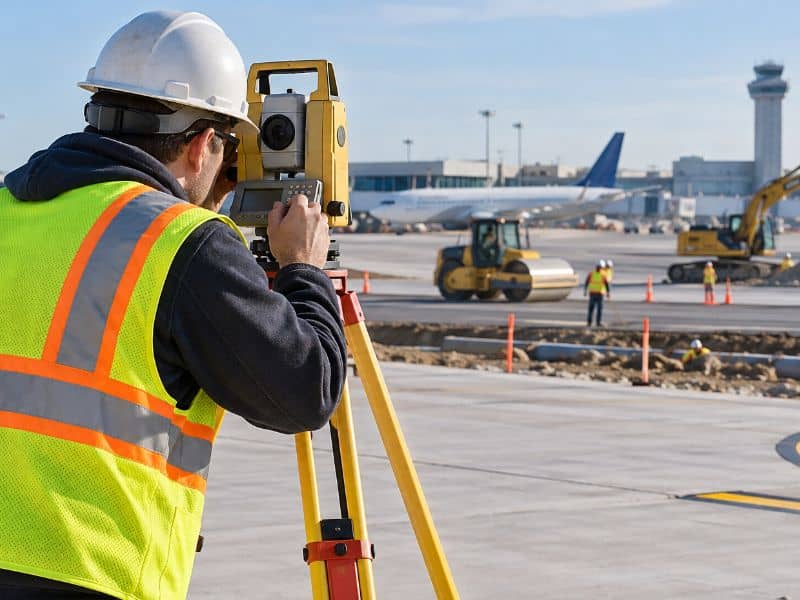
Airport pavement leaves very little room for mistakes. If a taxiway is off by even a tiny amount, water can pool on it. The pavement may crack early or fail an inspection. If an apron joint doesn’t line up with the next section, crews may have to cut it out and redo the work. A construction surveyor job is to stop these problems before they start. They do this by setting up and protecting a set of survey control points. If you’re a contractor, engineer, or airport owner, good control will affect your schedule and your final paperwork more than almost any other survey task.
Establishing Survey Control Before Airport Construction Begins
Survey control is a group of fixed points with known locations and heights. Every stake, grade check, and equipment setting on the job is measured from these points. At an airport, the surveyor usually starts from control points the airport already has. Those points are then tied to the same map system and height system used in the plans. Getting this right at the start keeps the plans, the layout, and the final records all in agreement.
Before any digging starts, the construction surveyor should find the existing survey markers. They check each one to see if it has moved or been damaged. Then they set new control points outside the work area, where heavy equipment won’t hit them. Many airport projects have extra rules for survey work, especially when federal money helps pay for the job. These rules can change based on the project, the funding, and the airport owner, so check with the project engineer early.
A few items belong on every checklist before work starts. Settling them now saves arguments later. Confirm these with your surveyor and design team:
- The map system and height system used in the plans
- Which existing control points the project must use
- Where new points can be set safely away from the work
- How often the points will be checked during construction
Getting onto an airport also takes extra planning. Survey crews may need escorts, badges, radios, and approved times to work near planes. Add that time to the survey schedule from the first day.
Maintaining Horizontal and Vertical Control Across Airport Aprons
An apron is a large paved area where planes park, load, and get fuel. It looks flat, but it isn’t. Each apron is built with gentle slopes that carry water to drains while staying safe for planes and ground vehicles.
Keeping control across a wide apron takes steady, careful work. Horizontal control means the surveyor keeps things in the right spot, like joints between pavement sections, tie-down points, and paint lines. Vertical control means they keep the height of the pavement correct so water drains the way the engineer planned. On a large slab, small mistakes can add up quickly.
Protecting Control During Phased Work
Most apron jobs are built in sections so the airport can stay open. This means control points may need to last for months right next to busy pavement. A good construction surveyor sets extra backup points and checks them between each section. When a new section begins, the first step is making sure the points still match the last section. That way, the new pavement lines up with the old pavement.
Construction Surveyor Control for Taxiway Grades and Alignment
Taxiways are the paved paths that connect runways to aprons and other parts of the airport. They must follow strict rules for their center line, their side-to-side slope, and their slope along their length. A construction surveyor has to hold those numbers through every layer, from the bottom soil to the top surface.
The work starts with the center line. Curves, wide corners, and spots where taxiways meet other pavement need careful layout. Even small shifts can show up later in paint lines, lights, and edges. Crews usually control height with stakes, tight string lines, or computer models loaded into their equipment. The surveyor should check each method against the control points.
Height checks matter at every step. The soil, the base layer, and the paving each get checked before the next layer goes on. Fixing a low spot in the base costs much less than grinding down or repaving finished pavement. If crews use computer-guided equipment, ask how often the surveyor will check it against real measurements on the ground.
Extending Survey Control Through Underground Utility Corridors
Airports depend on many buried lines. Storm drains, runway light wiring, power lines, fuel lines, water pipes, and phone or data lines often share narrow paths under or beside the pavement. Each line has to be placed in the right spot and at the right depth. Many of them also cross each other.
These utility paths can stretch a long way from the main control points. The construction surveyor carries control along the path by setting new points and measuring between them. Then they check back to known points to make sure nothing has drifted. Surveyors often place stakes off to the side of the trench, because digging would destroy any stake set right on the line.
Places where lines cross need extra care. Before digging, find out how deep the existing lines are and compare them to the new plans. Problems found on paper are cheap to fix. Problems found in an open trench next to a busy taxiway are costly and slow.
Verifying Airport Improvements With As-Built Survey Data
An as-built survey shows what was actually built. It records the location, height, and size of pavement, structures, and buried lines. At airports, this information is used for long-term records, future projects, and repairs. Some projects must also turn in this data in a certain format, and those rules can change based on the funding and the airport owner.
The best as-built data is collected while work is happening, not after it’s done. Buried lines should be measured before they’re covered with dirt. Pavement heights should be measured as each section is finished. Waiting until the end means guessing about what’s underground and rebuilding records from memory.
Ask your surveyor early what format the final files need to be in. Find out who will review them and when they’re due. The project will close out much faster when the data is organized from day one.
Frequently Asked Questions
What does a construction surveyor do on an airport project?
A construction surveyor sets up and protects the control points, marks where pavement and buried lines go, and checks heights as work moves along. They also collect as-built data that shows what was actually installed. At airports, they work closely with airport staff because of safety and access rules. Their work helps the contractor follow the plans and helps the owner approve the finished job.
Why is survey control so important on airport pavement?
Airport pavement must meet strict rules for height and position so it drains well and supports planes safely. Every stake and height check depends on the control points being correct. If the control is wrong, the mistake spreads across the whole project. Good control from the start prevents costly rework and failed inspections.
How often should control be checked during construction?
There’s no single rule for this. The right schedule depends on the size of the project, how many sections it has, and how busy the site is. Many surveyors check control before each new section and after anything that could move the points, like heavy equipment, digging, or bad weather. Agree on a check schedule with your surveyor before work begins.
